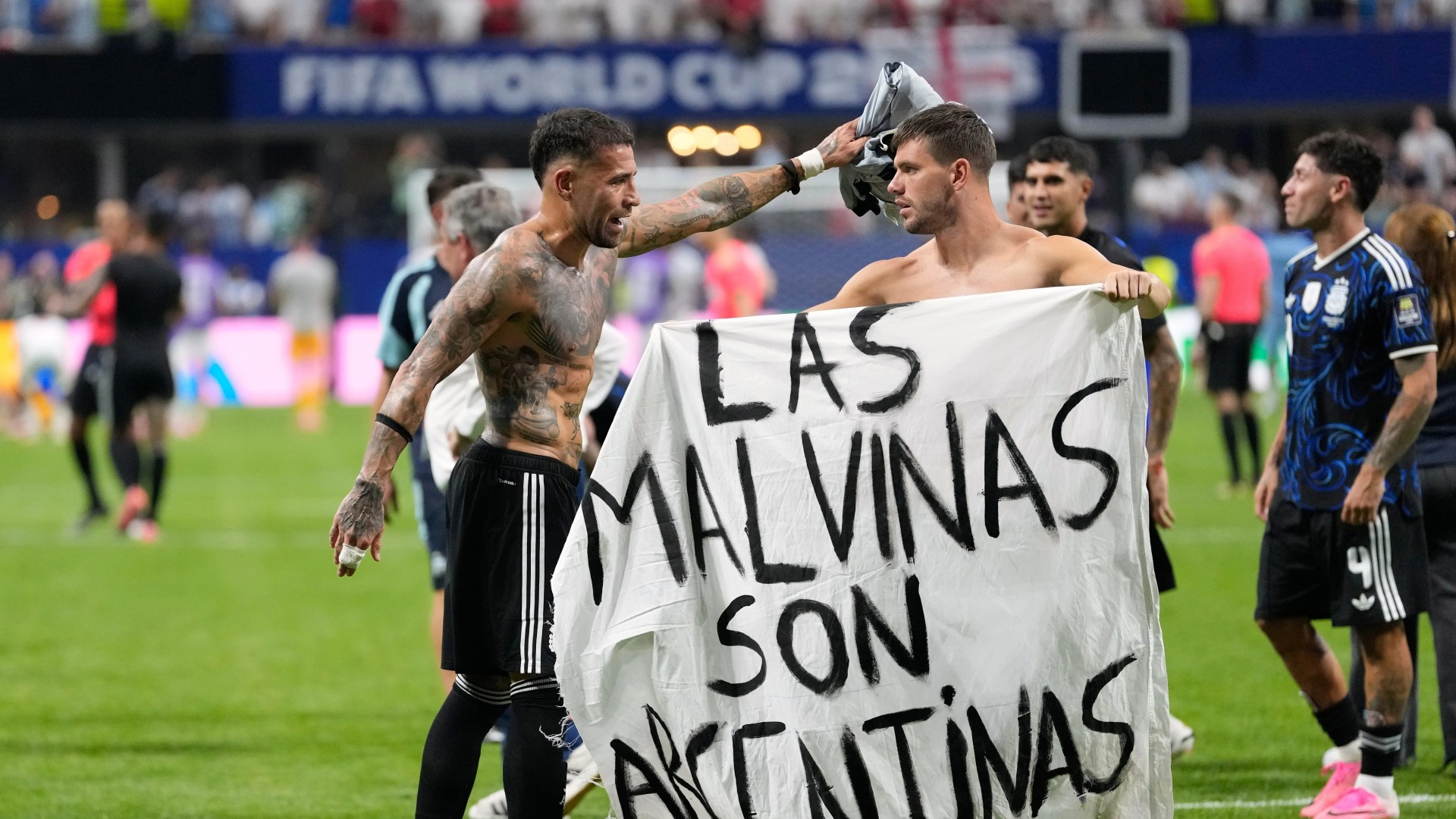
ARGENTINA broke English hearts after beating the Three Lions 2-1 in Wednesday night’s World Cup semi-final – but the victory has been overshadowed by a controversial banner.
Anthony Gordon’s strike left England fans believing this could be the year that 60 years of pain comes to an end.
But Enzo Fernandez’s brilliant strike, followed by a stoppage-time header from Lautaro Martinez, saw the reigning champions book their second consecutive World Cup final spot.
And after the final whistle, grinning players, including Manchester United’s defender Lisandro Martinez, paraded a banner across the field.
It declared “Las Malvinas son Argentinas”, referring to the British-administered Falkland Islands.
Now this incident is expected to trigger an investigation from Fifa, which could see players miss out on the showpiece match against Spain.


Will Argentina players be suspended for the World Cup final?
Fifa has not announced whether any players could be suspended just yet, leaving uncertainty over whether the incident will have consequences beyond a potential fine.
While Fifa’s sanctions will likely target the Argentine FA rather than individual stars, the fallout could still be felt in the Premier League when the 2026/27 season kicks off.
Several members of the Argentine squad – including Lisandro Martinez (Manchester United), Enzo Fernandez (Chelsea), Cristian Romero (Tottenham), and Alexis Mac Allister (Liverpool) – play in England.
But these players are unlikely to face domestic bans from the FA, as the incident occurred under FIFA’s jurisdiction at an international tournament.
Why was the Falklands banner controversial?
The Falkland Islands remain a sensitive subject, and the 1982 conflict between Britain and Argentina cost the lives of 255 British servicemen and 649 Argentine personnel.
The islands remained under British control following the 74-day war.
But by parading the slogan in front of a global audience immediately after defeating England, the Argentine team re-opened historical wounds on the pitch.
Fifa has strict rules designed to keep geopolitics out of football.
World football’s governing body bans “banners, flags, flyers, apparel and other paraphernalia that are of a political, offensive, and/or discriminatory nature” inside match venues.
Displaying political messages during or immediately after a match is a breach of these regulations, which exist to ensure football remains neutral.
What could Argentina’s punishment be?
England fans hoping for a dramatic reinstatement to Sunday’s final against Spain will be disappointed.
Under Fifa’s disciplinary code, political gestures of this nature almost always result in financial penalties rather than sporting sanctions.
The most likely outcome is a hefty fine for the AFA, perhaps exceeding the £20,000 handed out in 2014, alongside a formal warning about future conduct.
FIFA does hold the power to impose points deductions or event bans for extreme or repeated rule breaches, but there’s virtually zero chance that Argentina will be disqualified from Sunday’s final at MetLife Stadium.
While a ban from the World Cup final is unlikely, international governing bodies have previously suspended players for making sovereignty claims after defeating England.
Has anything like this happened in previous tournaments?
This is not the first time the Argentine Football Association (AFA) has landed itself in hot water over this exact banner.
In 2014, ahead of the World Cup in Brazil, Argentine players displayed the same “Las Malvinas son Argentinas” sign before a friendly match against Slovenia.
Fifa quickly opened disciplinary proceedings and slapped the AFA with a £20,000 fine for violating rules on team misconduct and “preventing political messages”.
In addition to this, during Spain’s trophy celebrations, the pair took to the stage in front of thousands of fans and led chants of “Gibraltar es Español” (“Gibraltar is Spanish”).
Gibraltar has been a British Overseas Territory since the 18th century.
Uefa’s disciplinary panel ruled that Rodri and Morata had violated the “basic rules of decent conduct” and used a sporting event for “manifestations of a non-sporting nature”.
Both players were forced to serve a one-match suspension during a Nations League match against Serbia.




Be First to Comment