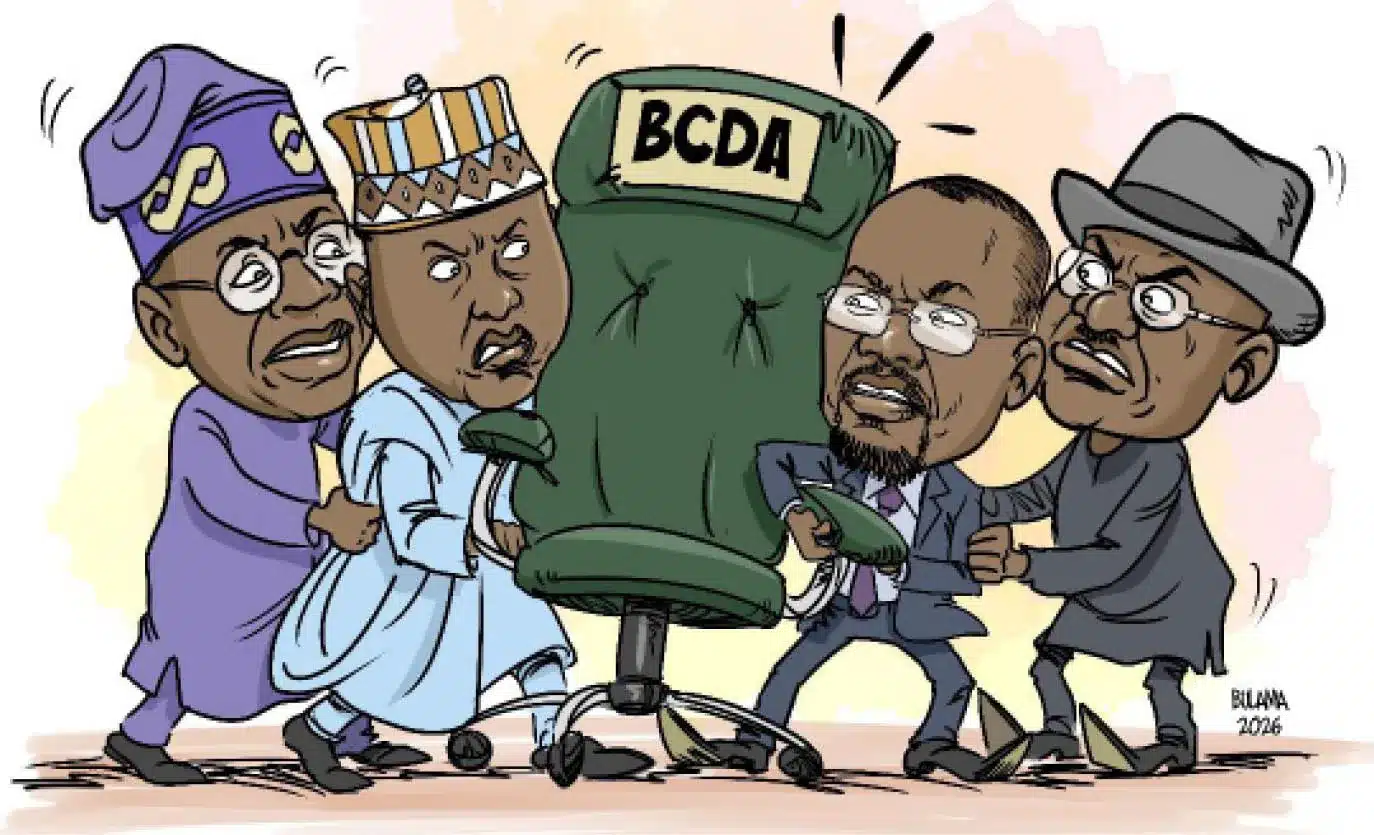
The leadership crisis at the Border Communities Development Agency (BCDA) has deepened as its embattled Executive Secretary, Dr Dakorinama Alabo George, insisted that President Bola Ahmed Tinubu’s directive requiring political appointees seeking elective offices to resign before the 2027 party primaries “does not stand.”
George, who was announced as having been replaced by former House of Representatives spokesman Abdulrazak Sa’ad Namdas, also maintained that there was no vacancy in the agency because he never resigned from office.
President Tinubu had directed all political appointees intending to contest elective positions in the 2027 general elections to resign on or before March 31, 2026.
George, a former Rivers State Commissioner for Works and a loyalist of the Federal Capital Territory (FCT) Minister Nyesom Wike, had reportedly resigned to contest the All Progressives Congress (APC) governorship primary in Rivers State but later withdrew before the primary election held on May 21.
On June 26, presidential spokesman Bayo Onanuga announced Namdas as the new Executive Secretary of the BCDA.
Despite the announcement, George has continued to function as the agency’s chief executive.
When previously contacted by Daily Trust, George said, “The Presidency through the office of the SGF will be in a better place to answer you.”
Responding to reports on the matter, he later insisted via WhatsApp that he remained the lawful occupant of the office.
“I have my appointment letter to the office and no one else does so there’s no dual leadership,” he wrote, while warning against what he described as misleading reports.
George argued that Section 88(1) of the Electoral Act only requires political appointees to resign before participating in party primaries and does not prescribe any earlier timeline.
According to him, because he withdrew before the APC governorship primary, there was no legal requirement for him to resign.
“The law is particular about not holding the appointment during participation on the day of the primaries.
“So if you withdraw from contesting a day before the primaries, you don’t need to resign. But if you’re really contesting you must resign at least a day before the primaries. The law didn’t say resign before picking forms. The law is the law and anything outside the law (even a directive) does not stand,” he said.
George further claimed that the Presidency was wrongly informed that he had resigned.
“So technically there was no vacancy. Someone erroneously misinformed the Presidency that there was a directive and an announcement was made but when they found out that there was no resignation it was quickly corrected,” he added.
However, presidential spokesman Bayo Onanuga had earlier dismissed George’s claim, stating, “Not true. Namdas stays.”
Senior Advocate of Nigeria, Salman Jawondo, said although Section 88(1) of the Electoral Act does not specify when a political appointee must resign before contesting a primary, the President retains the constitutional authority to appoint and remove political appointees at any time.
“The Electoral Act says you cannot be a delegate, an aspirant or a contestant at a party primary unless you have resigned your appointment. It does not stipulate any time frame.
“But the President is equally correct. Whether he resigns or not, the President can replace him with another person. By appointing another person, the President has dispensed with his services,” he said.
Jawondo added that George had no legal basis to continue occupying the office after another person had been appointed.
“Having appointed another person, that is the end of his appointment because he holds office at the pleasure of the President.
“My take is that he should stop parading himself as the occupant of that office. In the interest of his integrity, he should accept the President’s decision and leave. If he refuses, the state may have to invoke its lawful coercive powers to remove him,” the SAN said.
Another lawyer and human rights activist, Hameed Ajibola Jimoh, also disagreed with George’s interpretation of the law.
According to him, the Interpretation Act recognises that the authority that appoints an official also has the power to remove that official.
“The Presidency appointed him and has the discretionary power to also say his services are no longer required.
“This is not an elected office. The power to hire includes the power to fire.
“If the Presidency has shown the intention for him to leave, he cannot insist on remaining in office. When somebody is asked to leave office and refuses, there are procedures available to enforce that directive,” Jimoh said.




Be First to Comment