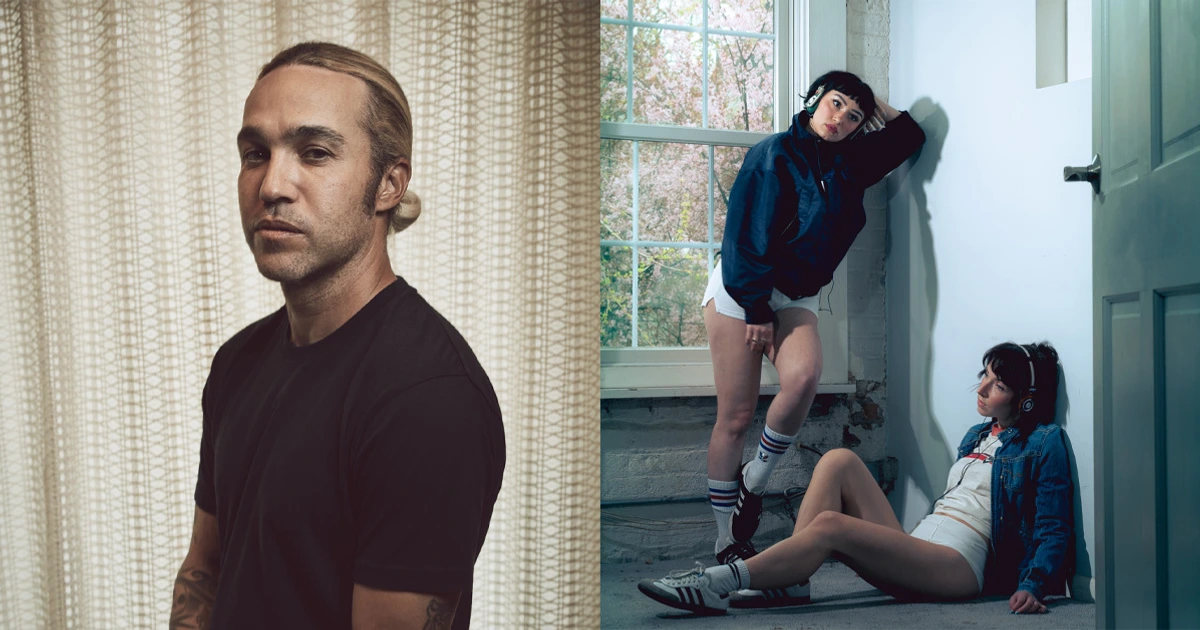
Daisy Grenade know a thing or two about theatrical storytelling. Since the release of their 2023 Cult Classic EP, Dani Nigro and Keaton Whittaker have spent their time relentlessly writing, touring, evolving, and building a dedicated community around their music — including Fall Out Boy’s Pete Wentz, an early supporter of the band. With their new EP, So Much to Say, they’re entering a chapter that feels more intentional and creatively ambitious while still leaning into the same alt-pop sensibilities they are known for.
Recorded live to tape in a church, the songs capture an immediacy that mirrors the themes running throughout the record — cycles of emotional patterns, longing, and self-reflection. “I used to feel so self-conscious about my lyrics that a lot of the most vulnerable ones I never shared because I was hyper-conscious about it,” Whittaker says. “Now, with more time, I feel so much less scared to bring something to other people and say, ‘This is from my journal, and it is very sad, but I think we can use it.’”
Read more: 10 great Fall Out Boy songs you’ve likely never heard
Outside the music, So Much to Say also expands Daisy Grenade’s cinematic world. Inspired by their backgrounds in musical theater and acting, they created an interconnected five-video visual narrative to accompany the EP, each chapter building toward a larger story about memory and emotional relapse. Taking on directing roles themselves for the first time, Nigro and Whittaker transformed a family home into the centerpiece of the project.
In conversation with Wentz, the duo discuss artistic growth, musical theater influences, the realities of creative partnership, and what comes next as Daisy Grenade step fully into their headline era.
PETE WENTZ: Sometimes when we make a record, two or three years later, I look back and realize there were things we did on that record we literally couldn’t have done before. Not necessarily because we didn’t know how to play something, but more in the process of making it. How did the process of writing and making this EP differ? Are there things you feel like you couldn’t have done on the last one?
KEATON WHITTAKER: Yeah, for sure. I think the entire process was different because we had some of these songs banked for so long. We didn’t know what would see the light of day, and then going back to figure out what the best project was isn’t a position we’ve ever been in before, because we didn’t have any songs written beforehand. This was the biggest bank of songs we could have possibly had to go through — it was picking and choosing from stuff we already really liked, which isn’t something we had the luxury of for the last couple of years. Our last EP was released in 2023, so we’ve been writing and writing.
DANI NIGRO: The first EP was truly the first set of songs we’d ever written together, so I think our ability as songwriters and lyricists had four years to get to where it’s at now, which allowed these songs to stand out.
WHITTAKER: To your point, I think it’s also a confidence thing that only comes with time. I used to feel so self-conscious about my lyrics that a lot of the most vulnerable ones I never shared because I was hyper-conscious about it. Now, with more time, I feel so much less scared to bring something to other people and say, “This is from my journal, and it is very sad, but I think we can use it.”
Jamie Rice
WENTZ: What would you say are the best and worst parts of being a songwriting duo? I’ll tell you mine first: The best part is how well you know each other. In a songwriting way, you finish each other’s sentences, but the worst part is also how well you know each other. Patrick [Stump] doesn’t abide by any of my bullshit. Trying to sneak something in or half-assing it, he just doesn’t go for it because he’s seen all the vulnerability.
WHITTAKER: You can’t get away with anything.
WENTZ: Same, and vice versa. It’s just how well you know each other. I didn’t know if you had thoughts on the best and worst parts.
NIGRO: I do have the worst parts. I think it’s similar. Time is the only thing that can create that kind of relationship. The best parts are definitely that Dani and I work so opposite from each other, from the way we approach things to what we start with and what’s important to us. It works perfectly because I’m rarely writing melody first — that comes much later for me. Dani is mostly melody first.
WENTZ: Very similar there.
WHITTAKER: I can send Dani a chunk of lyrics, and she’s like, “Oh, I have a hook that’s perfect for that,” or vice versa, and she’ll send me something, and I’ll have a chunk that works for it. That’s not always how it works, but it’s an example of our differences. Similarly, the worst part is that you can’t hide anywhere when somebody knows you that well.
WENTZ: There’s something beautiful about that, but it’s also not great sometimes.
WHITTAKER: Yeah, it’s scary for sure.
NIGRO: I think we do a really good job of yes, and-ing each other and pushing each other, especially when we’re writing in the same room together. We push each other to beat whatever it is we came up with. We very rarely come to disagreements. What makes Daisy Grenade so special is that we have a lot of overlap, but we also have very different musical tastes. Most of the time, they come together beautifully, and every once in a while, I like something she doesn’t like, or vice versa, and we have to find a way to bring them together. But it’s few and far between. Usually, it’s just a beautiful collaboration.
WHITTAKER: We had a 45-minute discussion — not even an argument — about changing one word in a hook on one of these songs, because I thought it helped tell the story, and Dani felt it muddled the meaning. Ultimately, we were trying to say the same thing, but the communication was missing. It was literally one word.
NIGRO: At the end of the day, it only matters to us.
WENTZ: But it matters so much to us. I disagree that it only matters to you. One word can change the whole meaning. Patrick and I have had words like that. He doesn’t mind “weep,” and that word drives me bananas. There are certain songs and pieces of art that would not be the same with a word change.
WHITTAKER: The lyric in “It Must Be Me” is now “I’m safe, you’re always sorry.” Originally, it was “not safe, you’re always sorry,” referring to the other person. I thought we should change it to “I’m safe, you’re sorry,” meaning I’m the safe choice, and you always pick the sorry choice. It was ultimately the same thing Dani was trying to say, but it personified it. I just couldn’t explain what I was trying to say, so it took us 45 minutes to disagree and then finally go, “OK, let’s just do this.” I’m grateful I have a partner who cares as much about those things as I do, even when the conversations are tough.
WENTZ: How has a musical theater background informed you as performers or writers in ways people maybe don’t know?
NIGRO: For me, my background in musical theater and acting allows me to take something personal that happened to me and put it into a fictional scenario. I don’t like writing literally, “This event happened, and these were the circumstances.” That doesn’t fulfill me the same way. Writing like I’m a character or in fictional circumstances still lets me express and process whatever it is, but it gives it a little more life and packages it differently. Sometimes things just aren’t as interesting as they could be written, so I like heightening things. That comes from theater acting for me.
WHITTAKER: I feel similarly. Something I haven’t talked about a lot is that I’m a huge Stephen Sondheim fan. I got to do one of his shows on Broadway when I was a kid — A Little Night Music — and I got to know him fairly well while he was alive.
WENTZ: It’s so cool to casually say, “This is the show I did on Broadway.”
WHITTAKER: It feels like it doesn’t count because it was so long ago, but it does. I became a really big fan of his writing, and a lot of his rules for writing musicals are applicable anywhere. One huge thing I think about all the time is “content dictates form.” The lyrical content dictates how the song should sound and feel. We’re always looking to evoke a feeling from the listener. Even if I like a melody better, if it doesn’t match the feeling of what we’re trying to say, it’s not right.
Another thing of his is “God is in the details,” which is exemplified by our one-word change. I remember we were doing a tech rehearsal and there was a lyric: “Short and boring?/Yes, he’s hardly worth ignoring.” Sondheim stopped everything and asked if the actor was actually short. Then he suggested “bland and boring” instead. One word changed the meaning of the next verse. I learned so much from him, and I think about those things constantly when I’m writing.
WENTZ: For pop or rock fans, musicals can seem intimidating or like a world unto themselves. What’s a musical everyone should see?
NIGRO: I think Rent is a perfect entry show for people who want to experience true musical theater but want something more sonically familiar because it’s a rock opera. It perfectly blends those two worlds. I love Rent.
WHITTAKER: I’d probably say Sweeney Todd. It does the thing that’s so great about musical theater, which is being completely epic. Musical theater is best when a story feels fullest being told through music. Sweeney Todd is weird and dark and thematic and freaky. If you’re a fan of us, you’d probably love Sweeney Todd. The story is fascinating, and the music is stunning.
WENTZ: I have a pretty big lack of knowledge of musical theater, and my daughter is really into musicals, so I’m always calling you for advice. Another thing I thought was interesting about this release is that you made five music videos telling one continuous story. What was the impetus behind that? And you both directed one, right?
NIGRO: Yep. It was definitely my first time directing. We’d been talking about wanting to do some kind of large-scale visual thing for LP1. We have so many filmmakers on our team, and we’re actors, so it’s another creative muscle we wanted to flex alongside the music. When this EP came around, it felt like the perfect opportunity to do a smaller-scale version of that — though it was not small at all. It was an unbelievably large undertaking.
We wanted a visual component because we love music videos as an art form. We wanted a cohesive story and a way to show that these songs are connected and have a through line. That’s how the short film was born. I directed the first video, and it was difficult. I’d love to direct something where I’m not also in it someday, because I just wanted to look at the monitor the whole time. But I’d absolutely do it again. We were under an insane time crunch with little to no crew help, so it was a team effort through and through.
WHITTAKER: Something I’m always asking when creating anything is “why?” Why is this a body of work? Why are these songs together? We worked backwards. We looked at the songs and realized they all dealt with getting stuck in loops or patterns. Every song had that feeling, so we came to the idea that the record is about relapse in its many forms.
Then we came up with the house concept because we realized we could shoot there for free. It was partially creativity and partially necessity. We knew we wanted something full for the record. I directed the last video, and Dani and I accidentally gave ourselves the hardest jobs because she had to establish the concept, and I had to land the plane.
I’d never directed a film before, only theater, so learning how the camera becomes another storytelling tool was fascinating. Luckily, our DP Jamie [Rice] was so talented and collaborative that it made everything easier, but it was definitely a challenge. I’d love to do it again, though I also don’t want to be in it because it’s so much harder to know what’s going on while you’re acting.
NIGRO: I just wanted to look at the monitor while lying on the floor.

Jamie Rice
WENTZ: We did an interconnected video series called the Young Blood Chronicles, and it was insane because we had no budget and filmed over a year. Continuity became a nightmare. But the craziest part was having Elton John in one of the videos. We were told very specifically: “Do not get any blood on Sir Elton John’s face.” Then, immediately, blood all over his face.
NIGRO: Did you get one take for that?
WENTZ: Oh yeah, one take. A guy like Elton John has a hard out. It’s one take, and then he leaves. But it really spoke to why he’s such a legend — he just rolled with it. There was also a moment where I was lying in a pool of fake blood and finally just got up and said, “I’m done. I’m not doing this anymore.” Enough dirt and fake blood.
WHITTAKER: It’s funny because the label gave us a budget and basically said, “You can do one video or two videos or whatever you want.” And we were like, “We’re gonna do five.”
NIGRO: It snuck up on us because we started with one and then thought, “We’ll do some visualizers.” Then, suddenly, we were making five full videos.
WHITTAKER: For context, what we made “Don’t Sweat It” on was probably less than the budget they gave us for all five. But we were like, “Fuck it, we’re doing five.” We shot four videos in five days. One of them we filmed at 4 in the morning.
NIGRO: During daylight savings time. We didn’t realize.
WHITTAKER: Suddenly, it turned 5 in the morning, and we were like, “Wait.”
NIGRO: We shot at my grandparents’ house. They let us go nuts.
WENTZ: Have they seen the videos?
NIGRO: Yes. My grandma texted me today saying she’s changing the name of the house so they can give tours when people want to come see it.
WENTZ: That’s either incredibly sweet or your grandma is an incredible hustler.
NIGRO: She loved it. The house means a lot to her and a lot to me, so they love seeing it.
WENTZ: Your first big headlining tour is coming up, too. What can we expect?
NIGRO: Music.
WENTZ: Perfect answer.
WHITTAKER: I think the set is going to feel very different from what people expect from us. People are very tuned in to what we wear and the overall aesthetic, which is cool, but this tour is going to feel much more stripped down and intimate, stylistically and production-wise.
The last two songs on the record are very different from our heavier pop-rock songs, and the final song feels like the heart of the record. That became the emotional center of the set. I’m really interested to see how people react to it.
NIGRO: We’re both playing a new instrument on the tour.
WENTZ: You can’t just say that and not explain.
NIGRO: It’s a surprise. This is kind of a spoiler, but I don’t care because I’ve spent so much time on it. We don’t really have room for full production because some stages are small, but we’re bringing a bunch of lamps. We don’t have a lighting designer, so I learned Lightkey, the lighting software, and figured out how to program the lamps to do things during the songs. That’s what I’ve been doing before this interview, and as soon as we get off this call, I’ll keep doing it. Nothing crazy, but something is happening.
WENTZ: I’m picturing you in your grandma’s house in the dark with lamps flashing on and off.
NIGRO: That’s basically me in my apartment. My poor fiancé had to go work in the bedroom while I sat surrounded by lamps blasting our songs. But it’s gonna be cool. Come check it out.




Be First to Comment