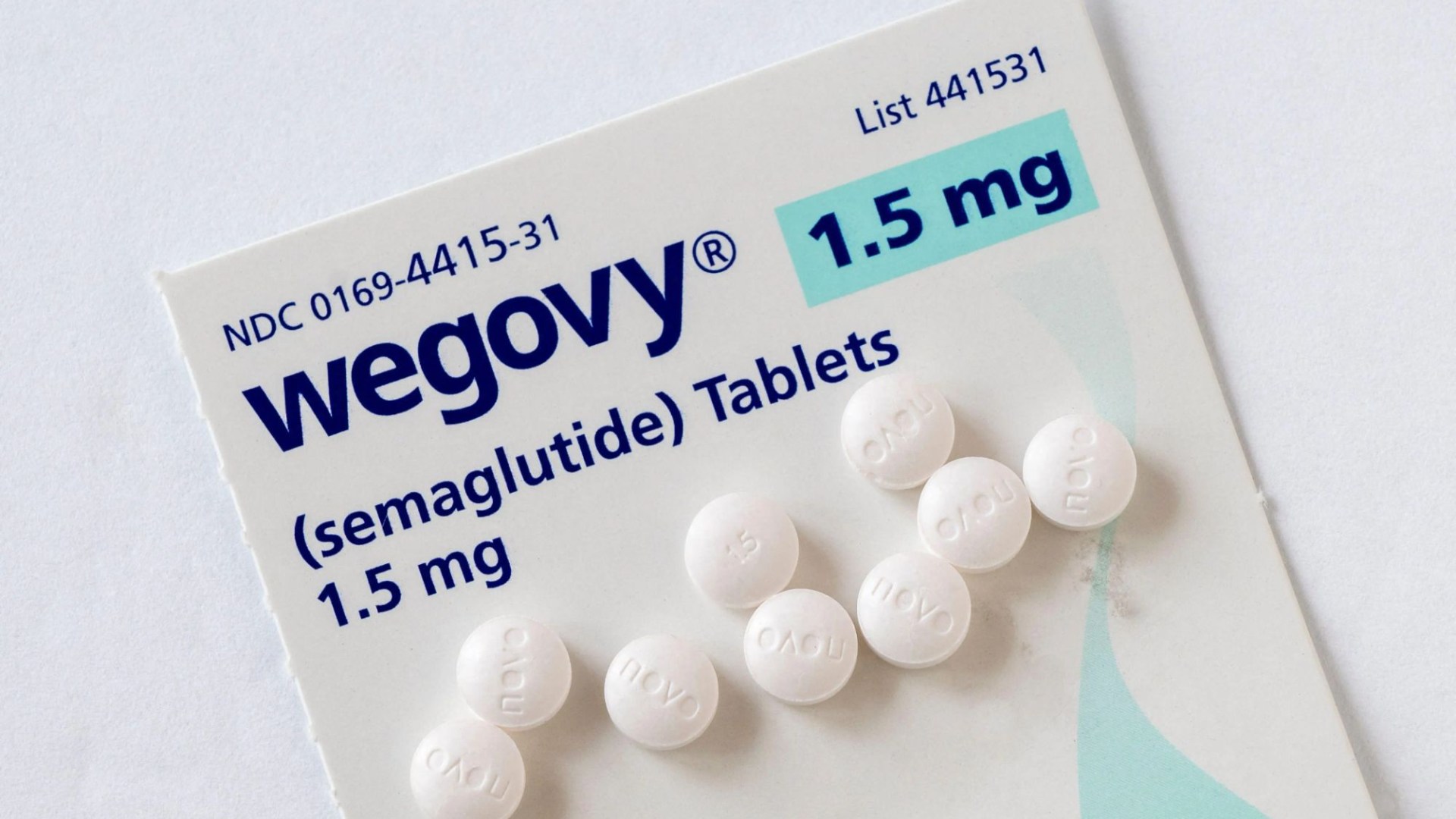
WEGOVY pills are just as good at shifting the pounds as rival obesity drugs but may not have the same heart benefits, the first head-to-head trial of the medications has suggested.
The blockbuster pill, produced by Danish pharmaceutical giant Novo Nordisk, is the first GLP-1 pill for weight loss now available in the UK.
But, Chinese researchers who assessed 19 currently available and emerging obesity drugs, have discovered the pills and other obesity drugs may not “meaningfully improve quality of life”, unlike some jabs.
In the study, published in the British Medical Journal (BMJ), researchers assessed 262 studies involving more than 99,000 patients on the various weight loss drugs.
Compared with lifestyle changes alone, the largest weight loss after one year was with Mounjaro (14.9 per cent) and Novo Nordisk’s new jab CagriSema that has not yet been approved ( 14.8 per cent).
This was followed by the Wegovy pill (10.9 per cent), orforglipron pill which is manufactured by Mounjaro maker Eli Lilly (9.9 per cent), the Wegovy jab (9.8 per cent), and phentermine-topiramate pills (8.1 per cent).

This drug is not approved in the UK and Europe due to safety concerns.
Emerging drugs – including retatrutide and mazdutide – showed large effects on weight loss but were supported by low or very low certainty evidence, researchers said.
Mounjaro led to the highest fat lost (by 25.7 per cent) but also the biggest loss of lean body mass such as muscle (8.3 per cent), the researchers also found.
They said the Wegovy jab was the only drug linked to a lower risk of death from any cause (19 per cent), heart attack (28 per cent) and heart failure (57 per cent).
Mounjaro reduced the heart failure risk by 51 per cent.
No drug convincingly reduced kidney failure or showed clinically-important improvements in quality of life, researchers also found.
The authors added that most clinical trials had a relatively short follow-up time, limiting conclusions about long-term safety, quality of life and effects on heart and kidney health.
In an accompanying editorial published in the BMJ, medics from the Cleveland Clinic in Ohio, US, said the study “represents an important step in providing comparative information” for patients and doctors “in this rapidly evolving landscape of treatment options”.
But experts, who weren’t involved in the study, urged caution over the findings.
Dr Marie Spreckley, a weight management researcher at the University of Cambridge, said: “The findings do not show that obesity medications have no wider health benefits.
“Rather, they highlight that while the evidence for weight loss is strong, evidence for some longer-term outcomes is still developing and differs considerably between individual medications.
“Many weight-loss trials were not primarily designed or sufficiently long to assess outcomes such as heart attacks, heart failure or mortality.
“The absence of demonstrated benefit for all medications should not be interpreted as evidence that these benefits do not exist.”
Meanwhile, Professor John Wilding, a professor of medicine at the University of Liverpool, added: “Trying to analyse all these drugs, alongside older and newer approved treatments and others that are in various stages of clinical development in one article is a tall order.
“Including drugs in early development with only very short-term data, means that data is incomplete..
“This distorts overall interpretation. Some of the included trials are also extremely short.
“Twelve weeks is not enough time to make any meaningful analysis, but any trial less than a year really should not be used to assess clinical benefit.”
Around two in three adults in the UK are obese or overweight, giving the UK one of the highest obesity rates in Europe.
In 2024, a sobering report also suggested that Britain’s spiralling obesity levels have fuelled a staggering 39 per cent rise in type 2 diabetes among people under 40, with 168,000 Brits now living with the illness.
Piling on the pounds has also been linked to at least 13 types of cancer and is the second biggest cause of the disease in the UK, according to Cancer Research UK.






Be First to Comment